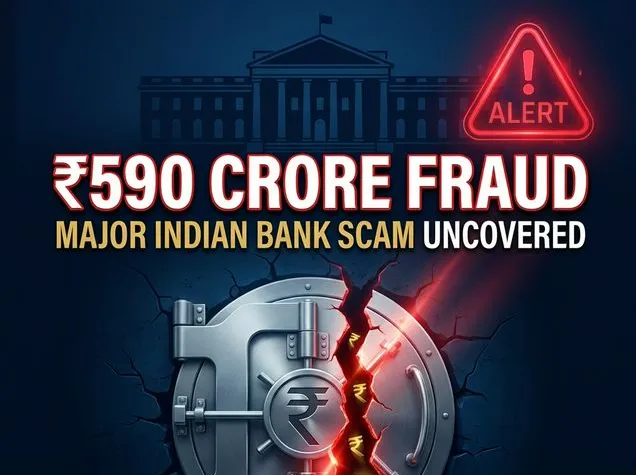
IDFC First Bank's ₹590 Crore Haryana Fraud: What Really Happened and What It Means for Investors
The disclosure of a ₹590 crore fraud in Haryana government accounts at IDFC First Bank isn't just another banking scandal. It's a case study in systemic vulnerability, internal oversight failure, and the fragile trust that binds government institutions to private sector banks.
How the Fraud Came to Light — And Why It Took So Long
The story began innocuously enough. A Haryana government department decided to close one of its accounts at IDFC First Bank's Chandigarh branch and transfer the funds to another lender. What followed was the kind of discovery that gives banking regulators nightmares: the amount on record was drastically different from the actual funds held in the account.
This is a crucial detail that many reports glossed over. This wasn't flagged by internal auditors. It wasn't caught by the bank's risk management systems. It was discovered by a government official doing routine paperwork. That single fact, more than the ₹590 crore figure, should concern every stakeholder in IDFC First Bank — and frankly, in the Indian banking system at large.
Once the first discrepancy surfaced, other Haryana government entities checked their own accounts. The results were deeply troubling: similar mismatches appeared across multiple accounts, all linked to the same Chandigarh branch. The total amount currently under reconciliation stands at approximately ₹590 crore.
The Anatomy of the Fraud
Based on what has emerged so far, this appears to be an insider-driven fraud. Certain bank employees — potentially working in collusion with external individuals — carried out unauthorized transactions that created a paper trail showing balances that did not reflect reality. Four officials have already been suspended pending investigation.
As an analyst, I see a few classic red flags in this pattern:
- Single-branch concentration: The RBI has already confirmed there is "no systemic issue" — the problem appears isolated to one specific branch. This is both reassuring and alarming. Reassuring because it's contained. Alarming because it means branch-level controls were insufficient to detect large-scale manipulation.
- Government account targeting: Government entities typically have large, relatively static deposits. They are not like retail customers who check their balances daily. This makes them attractive targets for fraudsters who count on delayed detection.
- Collusion structure: The phrase "in collusion with other individuals" suggests this wasn't a lone actor. Organized internal fraud of this scale requires multiple people looking the other way simultaneously.
IDFC First Bank's Response: Damage Control or Genuine Accountability?
To the bank's credit, the response has been reasonably swift. IDFC First Bank has appointed KPMG to conduct an independent forensic audit, expected to conclude in four to five weeks. The bank has also filed a police complaint and initiated recall requests to beneficiary banks — essentially trying to place liens on accounts where the fraudulently transferred money may have landed.
These are the right steps. But they raise a hard question: why wasn't KPMG or an equivalent firm conducting routine forensic audits of high-balance government accounts before this happened?
The bank has been at pains to assure the public that depositor money is safe and that recovery is underway. Haryana Chief Minister Nayab Singh Saini and RBI Governor Sanjay Malhotra have both offered assurances that the funds will be recovered. These are important signals for public confidence, but assurances are not the same as resolution.
The Haryana Government's Swift and Telling Response
Haryana's reaction has been decisive — and revealing. The state government immediately de-empanelled both IDFC First Bank and AU Small Finance Bank for government business with immediate effect. The matter was handed over to the Anti-Corruption Bureau (ACB) and the state's vigilance department.
The de-empanelment of AU Small Finance Bank alongside IDFC First Bank is worth noting. It suggests the state government's investigation may have uncovered links or suspicions that extend beyond just one institution. This is a thread investigators will need to pull carefully.
The involvement of the ACB rather than a standard police investigation also signals that the Haryana government suspects possible collusion with government-side officials as well — not just bank employees acting alone.
Market Reaction: The Investor's Dilemma
IDFC First Bank's share price fell sharply on the news, and this is where it gets interesting for investors. The market reaction, while understandable, may be creating a situation that rewards patience over panic.
Let me be clear about what this fraud is and what it isn't:
What it IS:
- A serious governance and internal control failure at a branch level
- A reputational blow that will cost IDFC First Bank in government business for the medium term
- A regulatory headache — the RBI will almost certainly conduct a special inspection
- A reminder that mid-sized private banks often punch above their weight in terms of ambition but can lag on controls
What it is NOT:
- The collapse of the entire bank
- Evidence of systemic fraud across multiple branches
- A deposit safety crisis (the RBI has been explicit that depositor funds are protected)
- Comparable to major bank failures — ₹590 crore, while significant, is not balance-sheet-threatening for a bank of IDFC First Bank's size
IDFC First Bank's total deposits run into tens of thousands of crores. The ₹590 crore under reconciliation, while serious, represents a fraction of the bank's overall book. The real damage is reputational, regulatory, and to future government business — not existential.
What Should Long-Term Investors Do?
Panic-selling after a fraud disclosure often creates opportunity. But that opportunity is only real if the institution is fundamentally sound and the fraud is genuinely contained.
Here's my analytical framework for thinking about IDFC First Bank post-disclosure:
- Wait for the KPMG report. The forensic audit in four to five weeks will either confirm the fraud is isolated or reveal something far more troubling. This is the single most important datapoint right now. Do not make significant investment decisions before this lands.
- Monitor the RBI's response. If the regulator imposes a corrective action framework or restricts business activities, that is a game-changer. If the RBI merely issues an advisory, the bank is likely through the worst of it.
- Track the recovery. How much of the ₹590 crore is actually recovered will define the ultimate financial impact. If KPMG's forensic trail leads to identifiable accounts, the recovery could be meaningful.
- Assess management credibility. IDFC First Bank's leadership needs to own this publicly — not just issue press releases. How the CEO and board communicate over the next 30-60 days will be telling about institutional character.
The Bigger Picture: A Warning for Indian Banking
India's banking sector has made enormous strides in digitization, credit risk management, and retail lending. But internal fraud — particularly at the branch level in mid-sized banks — remains an underappreciated risk.
Government accounts, with their large balances and infrequent reconciliation, are structurally vulnerable. Banks that hold government deposits should be conducting quarterly independent reconciliations of high-value accounts, not discovering discrepancies when a department decides to close an account.
The IDFC First Bank story is unlikely to be unique. It's the one that got caught. India's banking regulator would do well to use this moment to mandate proactive reconciliation audits for government-linked accounts across the sector.
Bottom Line
The ₹590 crore IDFC First Bank fraud is serious, embarrassing, and entirely avoidable. It reflects a branch-level breakdown in controls that never should have persisted long enough to reach this scale. The involvement of KPMG and the ACB suggests the investigation will be thorough — and the findings, when they come, could be uncomfortable for the bank's leadership.
For investors, this is not the moment to panic-sell or to "buy the dip" without caution. It is the moment to watch carefully, ask hard questions, and wait for the KPMG report before drawing conclusions.
For India's banking sector more broadly, this is a wake-up call about the vulnerability of passive, large-balance government deposits to insider fraud — and the urgent need for proactive reconciliation protocols that don't depend on a government clerk deciding to close an account to discover a half-billion-rupee discrepancy.
The author is an independent market analyst. This article is for informational purposes only and does not constitute investment advice. Readers should conduct their own due diligence before making any financial decisions.